How Much Weight Should I Add Each Workout?
By Boston Naviaux, founder of Lift Dungeon · Published May 19, 2026 · Updated October 17, 2026 · 8 min read
Beginners add 10 lb to lower-body lifts and 5 lb to upper-body lifts each session they hit every rep. After six months, halve those jumps. After two years, add 2.5 lb on lower-body lifts and 1 lb on upper-body lifts, and only once every set reaches the top of your rep range.
Most people add weight wrong: either too aggressively (form breaks down, you stall in a month) or too conservatively (you spend six months at the same numbers). The rules below are a clean rule of thumb you can take to the gym tomorrow.
How much weight should a beginner add?
A beginner adds 10 lb to lower-body barbell lifts and 5 lb to upper-body barbell lifts, in the session after every set reached the top of the rep range. The table shows the step for each training age:
| Lifting for | Lower body barbell | Upper body barbell | Isolation |
|---|---|---|---|
| Under 6 months | 10 lb (about 5 kg) | 5 lb (about 2.5 kg) | 2.5 to 5 lb (1 to 2.5 kg), or add reps |
| 6 months to 2 years | 5 lb (about 2.5 kg) | 2.5 lb (about 1.25 kg) | Add reps first |
| 2 years or more | 2.5 lb (about 1.25 kg) | 1 lb (about 0.5 kg) | Add reps first |
For scale, the American College of Sports Medicine's position stand recommends a 2 to 10% load increase once you can do the current load for one to two reps over your target. A 5 lb add to a 135 lb bench is about 4%.
If you're new to lifting (under ~6 months)
You're in the "newbie gains" window where your nervous system is rapidly getting better at recruiting muscle. Progress is fast and you should ride it.
- Lower body (squat, deadlift, leg press): add 10 lb per session, every session you hit your full rep range.
- Upper body push/pull (bench, overhead press, row): add 5 lb per session.
- Isolation lifts (curls, lateral raises, tricep work): add 2.5–5 lb when you can, or just add reps.
You'll feel like you're cheating. You're not. This rate of progress works specifically because you're new, and it stops working in a few months. Take advantage of it.
If you've been lifting 6+ months
Newbie gains taper off. Now you need to slow down or you'll burn out. The same numbers, halved:
- Lower body: 5 lb per session.
- Upper body: 2.5 lb per session.
- Isolation: add reps, not weight. Weight comes once you've maxed out the rep range twice in a row.
If your gym doesn't have 1.25 lb plates (a pair makes a 2.5 lb add possible on a barbell), buy a set. They stay in your gym bag and they're the difference between adding weight every week and adding it every three weeks.
If you've been lifting 2+ years
You're going to need micro-plates and patience. We're talking 1 lb on upper body, 2.5 lb on lower body, and only when every set of your last session hit the top of its prescribed rep range. Plenty of weeks you won't add weight at all. You'll add a rep or two and call it a win. That is the win.
What is the double-progression rule?
Double progression means you add reps inside a fixed range first, and add weight only once every set reaches the top of that range. You don't add weight every session. You add it when you've earned it.
Pick a rep range, say 5 to 8 reps. Then:
- Pick a weight you can do for 5 reps with good form.
- Next session, try for 6 reps at the same weight. Same form, same rest.
- The session after that, push for 7. Then 8.
- Once you hit 8 reps for every prescribed set, and only then do you add weight. Drop back to 5 reps at the new weight and start the climb again.
A worked example
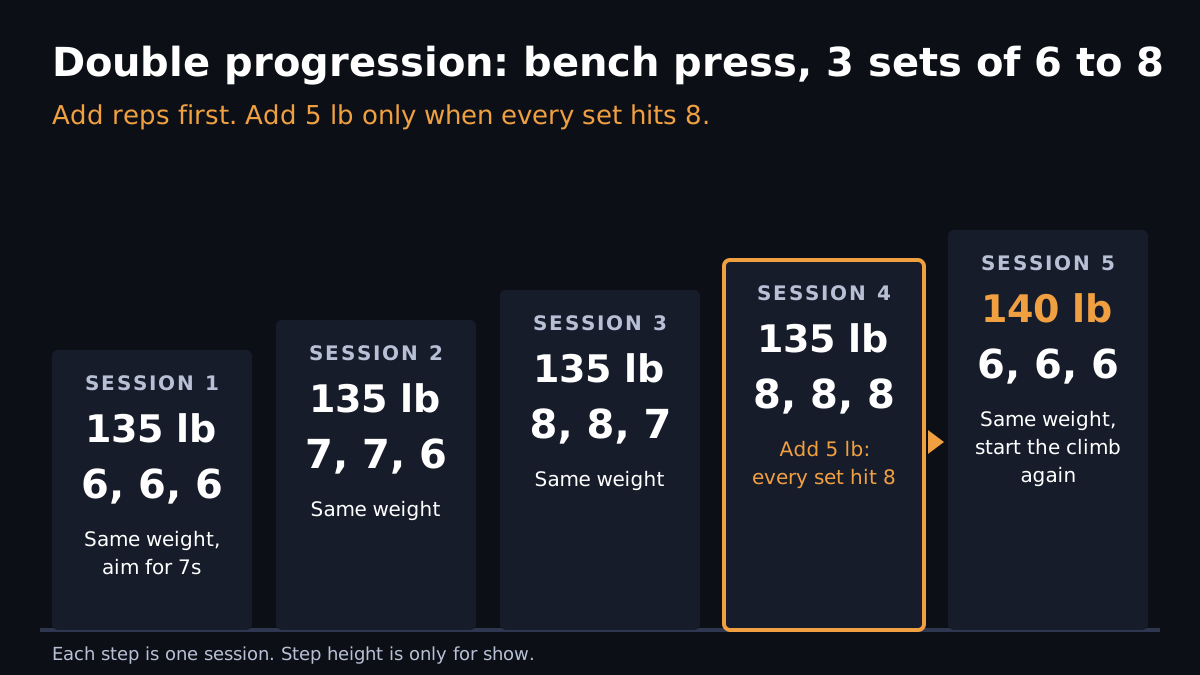
Bench press, 3 sets of 6 to 8 reps, starting at 135 lb, adding 5 lb at a time:
| Session | Weight | Reps per set | Next session |
|---|---|---|---|
| 1 | 135 lb | 6, 6, 6 | Same weight, aim for 7s |
| 2 | 135 lb | 7, 7, 6 | Same weight |
| 3 | 135 lb | 8, 8, 7 | Same weight |
| 4 | 135 lb | 8, 8, 8 | Add 5 lb: every set hit 8 |
| 5 | 140 lb | 6, 6, 6 | Same weight, start the climb again |
Four sessions to earn 5 lb looks slow next to adding weight every workout. The difference is that it keeps working long after plain linear progression has stalled.
Adding reps is a legitimate way to progress, not a consolation prize. In an eight-week trial of 43 lifters with at least a year of training, one group added load at a fixed rep range and the other added reps at a fixed load. Both approaches looked viable for building muscle and strength, and the differences between the groups were small.
When should you not add weight?
Hold the weight when your form broke down, you missed reps at the bottom of the range, you slept badly, or it's a deload week. The signs:
- Your form broke down last session. Bar speed slowed dramatically on the last reps, your back rounded, your knees caved. Repeat the weight until those reps look clean.
- You missed reps at the bottom of the range. If you were supposed to hit 5 reps and you only got 3, you didn't earn the next weight. Repeat.
- You're under-slept or fasted. Strength is downstream of recovery. Hold, don't try to PR on 5 hours of sleep.
- You're in a deload week. Built into most good programs every 4–6 weeks: weight stays the same or drops, sets go down, you recover. This is when growth actually happens.
How does Lift Dungeon decide your next weight?
Lift Dungeon runs this rule for every exercise, so you never have to work it out between sets. These are the numbers it actually uses:
- One step per exercise. 5 lb on barbell lifts (squat, deadlift, bench press, overhead press, row), 10 lb on the leg press, and 2.5 lb per dumbbell on dumbbell presses and most isolation lifts.
- Top of the range on every set: the weight goes up one step next time.
- Inside the range: same weight, aim for more reps.
- Below the range: repeat the weight. Miss again the next session and it drops about 10%, rounded to the nearest step, so you can build back up.
- Too easy: tap it after a lift and the next session jumps at least two steps. That covers the beginner window, when one step at a time is too slow.
- Too hard: the weight holds, and if you also missed reps it drops right away instead of waiting for a second miss.
- New lifts: the first session of a big lift ends with an ALL OUT set that calibrates your starting weight.
- Time off: a lift you haven't done for more than 8 weeks comes back about 10% lighter.
- Deloads: plans run in 6-week blocks, and week 6 is a lighter deload week.
So what's the actual answer?
Match the method to your training age:
Beginner: aggressive linear progression (5 lb upper, 10 lb lower) every session.
Intermediate: double progression: add reps first, then weight.
Advanced: micro-loads and patience, with planned deloads.
And track every set. The single biggest reason lifters stall isn't the wrong weight. It's not knowing what they did last time, so they can't tell if they actually progressed.
Common questions
Should I add weight every workout?
Only while you're new and hitting every rep. After the first few months, add reps first and add weight when every set reaches the top of your rep range. That's double progression.
How much weight should I add in kg?
The same steps, rounded to kilogram plates: about 5 kg on lower-body barbell lifts and 2.5 kg on upper-body barbell lifts while you're new, then about 2.5 kg and 1.25 kg once progress slows.
What if 5 lb is too big a jump?
On the bench and overhead press, 5 lb can be a big share of the weight. Use a pair of 1.25 lb fractional plates to add 2.5 lb, or stay at the weight and add reps until the jump feels manageable.
What should I do after missing reps twice in a row?
Drop the weight about 10% and build back up with double progression. Coming back from slightly lighter, with clean reps, usually gets you past the sticking point.
This is what Lift Dungeon does for you.
Lift Dungeon is the lifting RPG. A rule-based engine picks your next workout from your history: double progression, auto-progression, deloads, and PR tracking, built in, all wrapped in a game: pick a class, level a pixel-art character, and fight every exercise as a monster in Dungeon Mode. Free on iPhone, with optional Pro ($9.99/month or $59.99/year) and Ultimate ($14.99/month or $89.99/year) subscriptions for longer history, bigger parties and extras.
Download free